
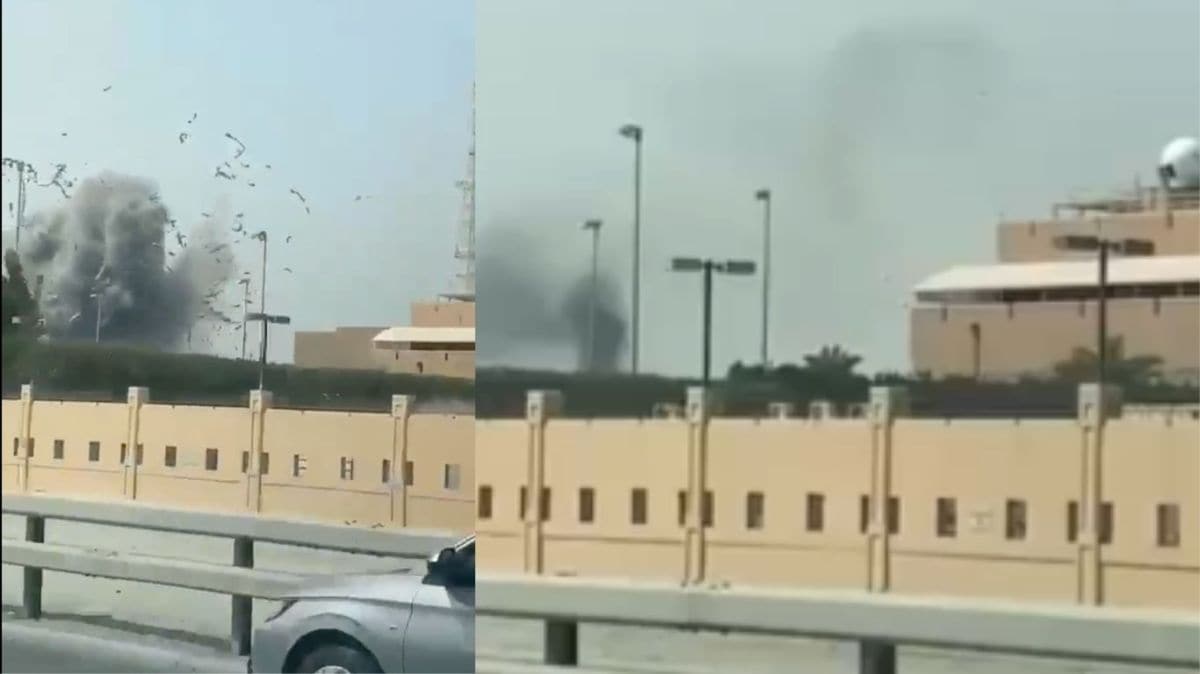
US Embassy in Bahrain Shuts Down After Manama Missile Strikes. The geopolitical landscape of the Middle East shifted dramatically on February 28, 2026, as a wave of missile strikes targeted the Kingdom of Bahrain, leading to the immediate and indefinite closure of the United States Embassy in Manama.
The escalation, which saw the U.S. Fifth Fleet’s headquarters in Juffair targeted, represents one of the most significant security breaches in the region in recent years.
As the smoke clears over the Manama skyline, the international community is left grappling with the implications of a direct confrontation involving regional powers and Western strategic assets. This article provides an in-depth analysis of the strikes, the closure of the U.S. diplomatic mission, and what this means for the future of Gulf security.
The Night Manama Shook: Details of the Attack
The assault began in the early afternoon of Saturday, February 28, 2026. Residents of Manama reported hearing a series of thunderous explosions followed by the distinctive wail of emergency sirens. According to official statements from the Bahrain Defence Force (BDF), the Kingdom’s air defense systems were activated to intercept a “hostile missile attack” launched from Iranian territory.
While the BDF successfully neutralized several incoming projectiles, the National Communication Centre (NCC) confirmed that at least one missile struck a service center affiliated with the U.S. Navy’s Fifth Fleet in the Juffair district.
Key Events of the Strike:
- Targeting Juffair: The Juffair area, which houses a massive concentration of U.S. military personnel and their families, was the primary focal point of the attack.
- Evacuation Orders: In the immediate aftermath, the Ministry of Interior began the urgent evacuation of citizens and residents from the Juffair neighborhood to ensure public safety.
- Regional Context: The strikes were not limited to Bahrain. Reports indicate that Iran launched a coordinated retaliatory wave across the Gulf, targeting U.S.-linked sites in Qatar, Kuwait, the UAE, and Jordan.

U.S. Embassy Responds: Immediate Closure
By Saturday evening, the U.S. Embassy in Manama issued a high-priority security alert. Citing “ongoing missile strikes,” the State Department announced that the embassy would remain closed to the public starting Sunday, March 1, 2026.
Suspension of Services
The closure is comprehensive. All regular and emergency consular appointments, including visa interviews and American Citizen Services (ACS), have been canceled. The embassy has not yet provided a definitive timeline for reopening, stating only that operations will resume once the security situation is deemed stable.
Guidance for U.S. Citizens
The embassy has urged the thousands of Americans living in Bahrain to maintain a high state of vigilance. The current “Shelter-in-Place” advisory includes several critical instructions:
- Seek Cover: If an explosion is heard or sirens sound, individuals should move to the lowest level of a building, staying away from windows and exterior walls.
- Beware of Debris: Even intercepted missiles pose a threat. Falling debris can be lethal and may contain hazardous materials.
- Enroll in STEP: The embassy is strongly encouraging all citizens to register with the Smart Traveler Enrollment Program (STEP) to receive real-time security updates directly to their mobile devices.
The Geopolitical Catalyst: Why Now?
To understand why the U.S. Embassy in Bahrain has shuttered its doors, one must look at the broader “tit-for-tat” escalation between the U.S., Israel, and Iran.
Earlier on February 28, Israel launched a preemptive military operation titled “Lion’s Roar,” aimed at degrading Iran’s missile launch capabilities. Simultaneously, the U.S. administration, led by President Donald Trump, announced “major combat operations” within Iran to eliminate what was described as an “imminent threat” to American interests.
Tehran’s response was swift. The Islamic Revolutionary Guard Corps (IRGC) framed the strikes on Manama as a direct retaliation for these attacks. Bahrain, as the host of the U.S. Fifth Fleet, occupies a precarious position as the literal and figurative “front line” of U.S. naval power in the Persian Gulf.
Impact on the Kingdom of Bahrain
For the Kingdom of Bahrain, the strikes represent a violation of national sovereignty. The Bahraini government has issued a staunch condemnation, characterizing the attacks as “criminal aggression” that disregards international law.
Economic and Social Disruptions
The closure of the U.S. Embassy and the attacks on Juffair have sent shockwaves through the local economy:
- Airspace Closure: Bahrain, along with Kuwait and Syria, implemented temporary and partial airspace closures, disrupting international travel and logistics.
- Market Volatility: While Bahrain has worked tirelessly to position itself as a safe haven for investment and tourism (notably with the “Celebrate Bahrain” season), these security shocks threaten to undermine investor confidence.
- Public Safety: The Ministry of Interior continues to monitor sites for unexploded ordnance and debris, advising the public to report any suspicious objects to the 999 emergency line.
What Happens Next?
The closure of the U.S. Embassy is a symbolic and practical blow to regional stability. Diplomatically, it signals that the U.S. views the current threat level as unsustainable for non-combatant staff.
Potential Escalation
Military analysts are watching closely to see if the U.S. Fifth Fleet will launch counter-strikes from its base in Bahrain. If the base continues to be a target, there is a possibility that the U.S. may further draw down its non-essential diplomatic presence, a move that would mirror the “Maximum Pressure” era of the past but with much higher kinetic stakes.
Diplomatic Efforts
Despite the closure, back-channel communications—often mediated by Oman—are likely still active. However, with the U.S. Supreme Court and the Trump administration focused on “America First” policies and emergency authorities, the path to de-escalation remains murky.
Conclusion
The shutdown of the U.S. Embassy in Bahrain after the Manama missile strikes marks a “red alert” moment for the Middle East. It is a stark reminder of how quickly regional tensions can boil over into direct conflict, affecting the lives of thousands of expatriates and local citizens. For now, the world waits to see if this is the peak of the crisis or merely the beginning of a larger regional conflagration.
As we monitor the situation, the safety of civilians remains the highest priority. Stay tuned to official government channels for the latest updates on embassy operations and security protocols in the Kingdom.